Bank vs Currency Exchange Provider: Which One Actually Gives You Better Rates?
Here is a situation most Australian travellers have been in at least once. You are a few weeks out from an international trip, you need to sort your foreign currency, and the easiest thing to do seems to be walking into your bank and asking them to sort it out. They already have your account. You trust them with your mortgage, your savings, and your daily transactions. Surely they will do right by you on a few hundred dollars worth of US Dollars or Euros?
It is a reasonable assumption. It is also, in most cases, a costly one.
The reality is that banks and specialist currency exchange providers operate on very different pricing models when it comes to foreign cash. Understanding the difference between the two is one of the simplest ways to stretch your travel budget further before you even step on a plane. This guide breaks down exactly how each option works, where the real cost difference lies, and which choice makes the most sense depending on your situation.

How Banks Price Their Foreign Currency
To understand why banks rarely offer the best exchange rates, it helps to understand what exchange rate you are actually being quoted.
Every currency pair in the world has what is called a mid-market rate. This is the midpoint between the global buy price and the sell price for that currency. It is the rate you see when you type AUD to USD into Google or check xe.com. It is the rate at which banks trade with each other on the wholesale market.
Retail customers, however, do not get the mid-market rate. Every provider adds a margin above it to cover their costs and generate profit. The question is simply how wide that margin is.
For the major Australian banks, that margin on foreign currency cash typically sits between 3 and 5 percent above mid-market. On top of that, some banks charge an additional flat handling fee or ordering fee depending on the currency and the branch. The combined effect on a typical travel money conversion is significant.
Real numbers: Converting AUD 3,000 into US Dollars at a 4 percent margin above mid-market means you are effectively paying AUD 120 for the privilege of the conversion. That money does not go toward your trip. It goes to the bank.
There are a few other practical limitations worth knowing about when using a bank for foreign currency:

How Specialist Currency Exchange Providers Price Their Rates
Specialist currency exchange providers exist for one purpose: buying and selling foreign currency. That focus changes the entire pricing structure.
Because foreign exchange is the core business rather than a supplementary service, specialist providers trade in significantly higher volumes. Higher volume means tighter wholesale pricing from their own supply sources, and those savings flow through to the retail rates they offer customers.
The margin that a reputable specialist provider charges above mid-market typically sits between 1 and 2.5 percent for major currency pairs. That is a meaningful difference compared to the 3 to 5 percent commonly charged by banks.
On that same AUD 3,000 conversion into US Dollars, a specialist provider charging a 1.5 percent margin means you are paying AUD 45 rather than AUD 120. The extra AUD 75 stays in your pocket, which in practical travel terms could mean a well-priced dinner for two, a day of sightseeing, or a comfortable taxi from the airport rather than a budget shuttle.
The pricing model is also more transparent. Reputable specialist providers like Danesh Exchange do not charge flat commission fees on top of the rate. What you see in the calculator is what you pay. No surprises at the checkout screen.

Banks vs Specialist Providers: A Side by Side Comparison
| Major Australian Bank | Danesh Exchange | |
| Typical margin above mid-market | 3 to 5 percent | 1 to 2.5 percent |
| Commission or flat fees | Often yes | Zero commission |
| Stock availability | Order in advance, 3 to 7 days lead time | Allocated at time of order |
| Online ordering | Limited, branch visit often required | Full online platform with live rates |
| Delivery options | Branch collection only | Home delivery or Click and Collect |
| Rate transparency | Rate sometimes varies by branch | Rate locked in at time of order |
| AUSTRAC regulated | Yes | Yes |
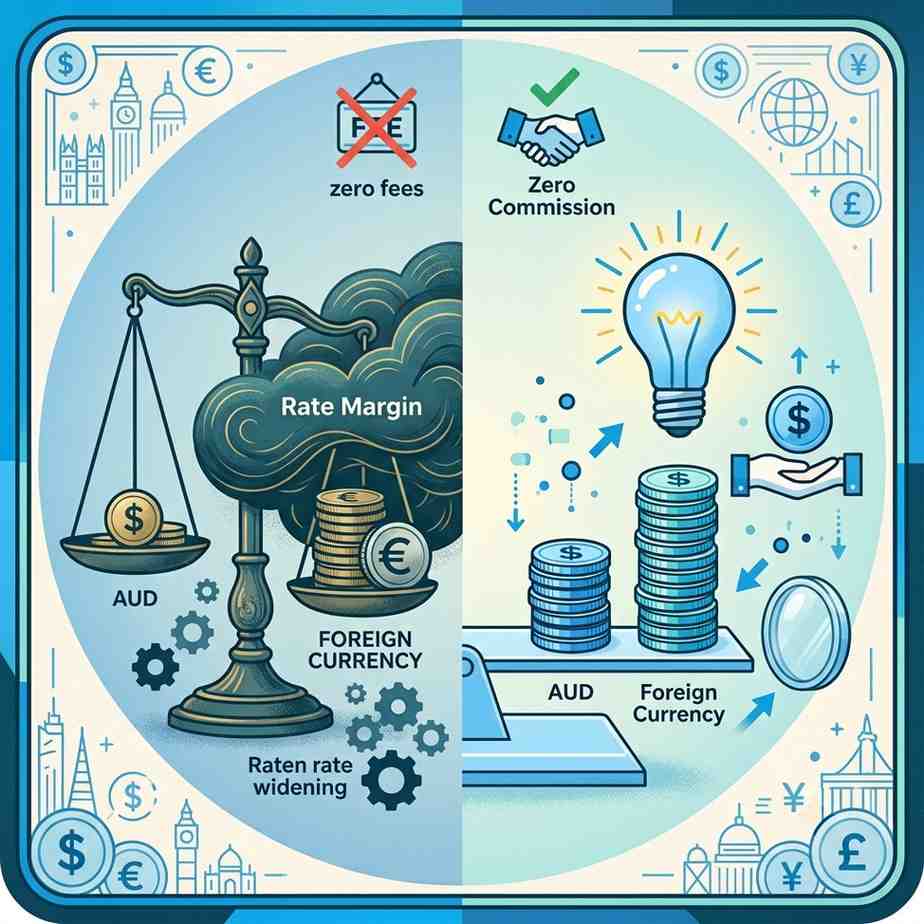
The "No Fee" Claim: What It Really Means
One thing worth addressing directly is the language around fees and commissions in the currency exchange market. It is common to see signage at bank branches, airport kiosks, and even some online providers that advertises zero fees or no commission.
In most cases, that claim is technically true but financially misleading. When a provider removes an explicit flat fee, they typically widen their rate margin to compensate. The cost to you remains the same or higher, it is simply embedded in the rate rather than listed as a separate line item.
The only meaningful way to compare any two currency exchange options is to calculate the total amount of foreign cash you receive for the Australian dollars you hand over. The provider who gives you the most foreign currency for your AUD is the better deal, regardless of what their fee structure says.
At Danesh Exchange, zero commission genuinely means zero commission. There are no embedded rate adjustments to recover a hidden handling fee. The live rate in the calculator is the rate you lock in.
When Does Using a Bank Actually Make Sense?
To be fair, there are situations where exchanging currency through your bank is a reasonable choice rather than a poor one.
- Small amounts: If you only need a small amount of foreign cash, say under AUD 200, the rate difference between a bank and a specialist provider may be marginal in absolute dollar terms. Convenience might reasonably outweigh the saving.
- Existing relationship benefits: Some premium banking packages or accounts with international travel features offer reduced margins on foreign currency. If you hold one of these products, check the effective rate before assuming a specialist is automatically cheaper.
- Emergency situations: If you genuinely need foreign cash the same day and cannot access an online platform or specialist provider in time, a bank branch may be your most practical option. In that case, treat the rate difference as the cost of the convenience.
Outside of these specific scenarios, the rate difference between banks and specialist providers is consistent and meaningful enough that most Australian travelers are better served by planning ahead and ordering online.


How to Get the Best Currency Exchange Rate in Australia
Whether you are heading to the United States, Europe, Japan, Bali, or anywhere else, a few straightforward habits consistently deliver better rates on your travel money:
- Always check the mid-market rate before you compare any provider. This gives you a genuine benchmark rather than relying on one quote alone.
- Order your foreign currency at least one to two weeks before your departure date. This removes the last-minute pressure that pushes travellers toward expensive options.
- Use an online specialist platform to lock in a live rate from home. Online platforms carry lower overhead and pass those savings on through sharper pricing.
- Calculate what you will actually receive, not just what the headline rate or fee structure says. Total foreign currency received per AUD spent is the only honest comparison.
- Avoid exchanging large amounts at the airport unless it is genuinely unavoidable.
What About Airport Currency Exchange Kiosks?
If banks sit at the more expensive end of the market relative to specialist providers, airport kiosks occupy a category of their own. Margins at Australian international airport currency desks routinely run between 8 and 12 percent above mid-market rates.
The reason is straightforward. Airport operators charge premium rents for terminal floor space, and kiosks face virtually no local competition once you are past the security gate. The pricing reflects that captive market environment rather than any genuine effort to offer competitive rates.
Airport kiosks serve a genuine purpose for travellers who have completely overlooked their currency needs until the last possible moment. But for anyone who has planned even a week or two ahead, they represent the most expensive way to buy foreign cash available in Australia.
Quick tip: If you find yourself at the airport without any local currency for your destination, limit your airport exchange to a small emergency float, just enough for a taxi and immediate arrival costs. Order the bulk of your currency online before your next trip.

Frequently Asked Questions
Is it safe to buy foreign currency from an online provider rather than a bank?
Yes, provided the provider is registered with AUSTRAC and holds the relevant Australian financial services credentials. Reputable online specialist providers like Daneesh Exchange are fully regulated, use identity-verified shipping, and operate under the same Australian financial compliance framework as banks. The delivery and collection process is secure, tracked, and requires photo ID.
Do banks offer better exchange rates for existing customers?
Some premium bank accounts include reduced foreign currency margins as part of their product features. However, even with these benefits, the effective rate offered by most bank products still sits above what a specialist provider offers at retail. It is always worth comparing the two before committing, particularly on larger conversions.
Why does the exchange rate change between the time I check and the time I buy?
Currency markets move continuously during trading hours. The AUD to USD, EUR, JPY, and other major pairs fluctuate in real time based on economic data, global events, and market sentiment. When you lock in a rate through Daneesh Exchange, that rate is confirmed at the point of your order, so you are protected from any movement between ordering and receiving your currency.
Can I order foreign currency online and collect it from a location near me?
Yes. Danesh Exchange offers Click and Collect from over 3,000 Australia Post locations across the country. You can lock in your rate online and collect your currency at a time and location that suits your schedule. Home delivery is also available for those who prefer their currency sent directly to their door.

The Verdict
For the vast majority of Australian travellers converting AUD into foreign currency, a specialist provider consistently outperforms a bank on rate, convenience, and transparency. The margin difference is real, the process is straightforward, and the savings on even a mid-range travel budget are worth the small amount of advance planning required.
Banks serve a purpose, and for many financial needs they remain the right choice. Foreign currency exchange is simply not one of the areas where they compete on value.
Danesh Exchange offers competitive live rates across all major travel currencies including US Dollars, Euros, Japanese Yen, Indonesian Rupiah, and more, with zero commission and flexible delivery options across Australia. Check today’s rates on our Currency Exchange Australia page, or visit our Currency Exchange Melbourne and Currency Exchange Sydney locations for in-person service.